
Handing a live coding session to a different AI agent
You're forty turns deep into a session. The agent has the whole shape of the problem in its head — the failing test, the half-finished refactor, the three approaches you already ruled out — and it isn't getting there. A different model might. But switching used to mean starting cold: new terminal, new agent, and you retyping everything the last one already knew.
BattleLab now hands a live session to another engine. Take a running session with one agent, move it to another, and the new one starts with the context already in front of it — no copy-paste, no re-explaining.
What a hand-off carries
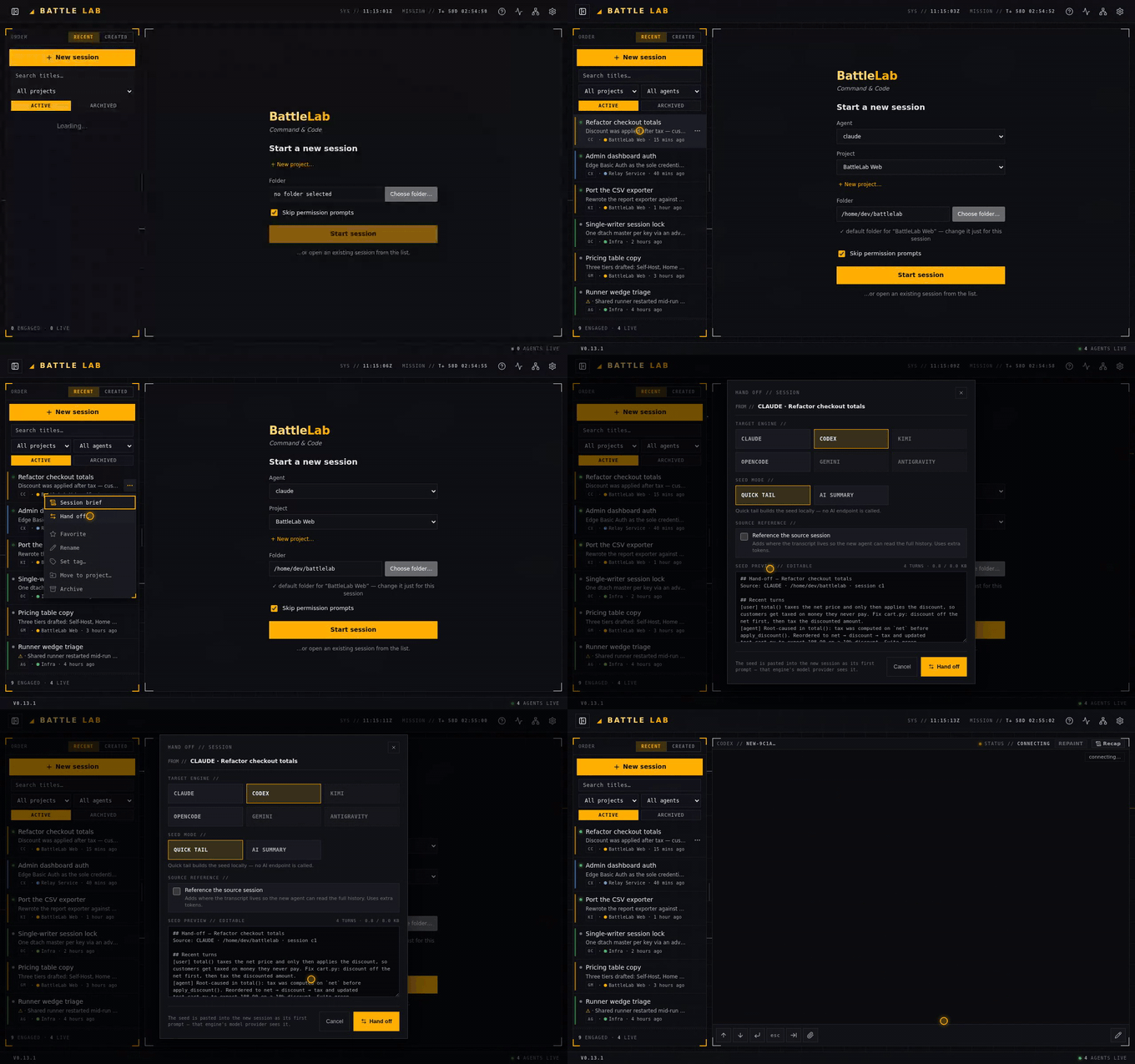
Hit ⇄ Hand off — from inside the session, or straight from a row's ⋯ menu without opening it — pick a target engine, and you get a preview of the brief that will start the new session. There are two ways to build it:
- Quick takes the last few turns and renders them into an engine-neutral document — no Claude-isms leaking into Codex.
- AI asks your own review endpoint to write a proper handover note: current state, open items, next steps.
The brief is editable before you send it, so you can trim a tangent or add a line of intent. Confirm, and a fresh session opens in the target engine with the brief already in place as its first prompt.
It lands as a paste — and says so
The brief reaches the target the same way you would: a paste into its terminal as the first prompt. Never on a command line, never in a URL — a hand-off brief is the densest artifact in the whole system, the distilled state of your work, and it stays out of anything a process list or an access log could scrape. The modal tells you exactly what's happening: this gets pasted into the new session as its first prompt, and that engine's model provider sees it. And if your AI review endpoint isn't configured or is unreachable, the hand-off doesn't fail — it falls back to the Quick brief and says so.
Both ends know where it came from
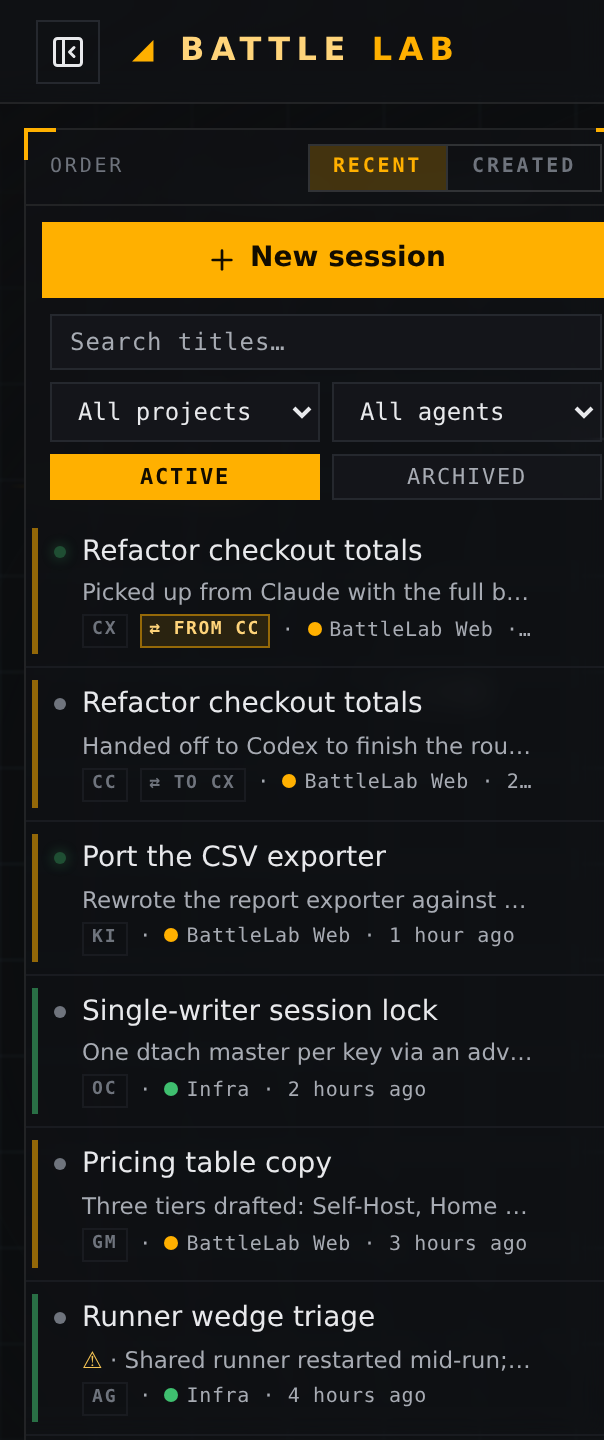
Both halves of a hand-off carry a badge in the sidebar — ⇄ FROM on the new session, ⇄ TO on the old — each a tap-through to its peer. You can always see which session a piece of work came from, and where it went next.
Which engines
Today you can hand off between Claude Code, Codex, and opencode. Gemini, Antigravity, and Kimi Code don't have a seed-capable start path yet, so they show up in the picker greyed out with the reason written on the tile — a disabled control should always tell you why.
Hand your work to whichever agent will finish it → battlelab.superstatus.io
// COMMS