
Gameplayce: what I built with AI agents, so we'd have a reason to put them away
These days most of my working hours involve machines. Agents plan my changes, write the code, review each other's pull requests, merge, and deploy. I wrote about the harness behind that in Forgehand. It works well. Well enough that a question started to bug me:
If the machines are doing more of the work, what are the rest of us doing with each other?
Gameplayce.io is my answer. It's a party-games platform for people in the same room. And, fittingly, it's mostly been built by agents.
Two experiments in one
Gameplayce started as a test bed. I wanted a real product, not a toy repo, to find out how far autonomous software development actually goes. It needed real users, a real design system, auth, realtime multiplayer, deploys, and all the dull parts that break.
Here are the numbers since the first commit in March 2026:
- 1,232 commits, about 69% of them by the agent identity rather than by me typing
- 956 pull requests, every one reviewed by an AI reviewer before merge
- 760 issues, most opened, refined and closed in the same agent loop
- 9 games live or in beta, on one shared platform
The loop is the same one I use everywhere. An issue gets a fixed shape (Overview, Goals, Architecture, Phases, Risks, Out of scope). A reviewer bot sanity-checks the plan. An agent claims it, works in its own isolated checkout, opens a PR, and iterates against the reviewer until it's approved and CI is green. Then it merges and watches staging until the change is actually live. Production deploys still go through me. Anything that touches design gets a rendered mockup before a line of UI code is written, and UI fixes have to show a real-browser test that fails first and passes after.
What did I learn? Agents are fast. The real bottleneck is clear rules: what "done" means, what's off-limits, and when to stop and ask a human. With a good workflow, a one-person side project ships a catalog. Without one, you get a very confident mess.
But the experiment was never only about the code.
Why party games
The other half of Gameplayce has nothing to do with productivity.
We spend our days with screens, tools, agents and dashboards. I like that work. But the more of it machines take on, the more I think the human part, sitting in a room with people and laughing at something dumb, needs protecting on purpose. It won't happen by default.
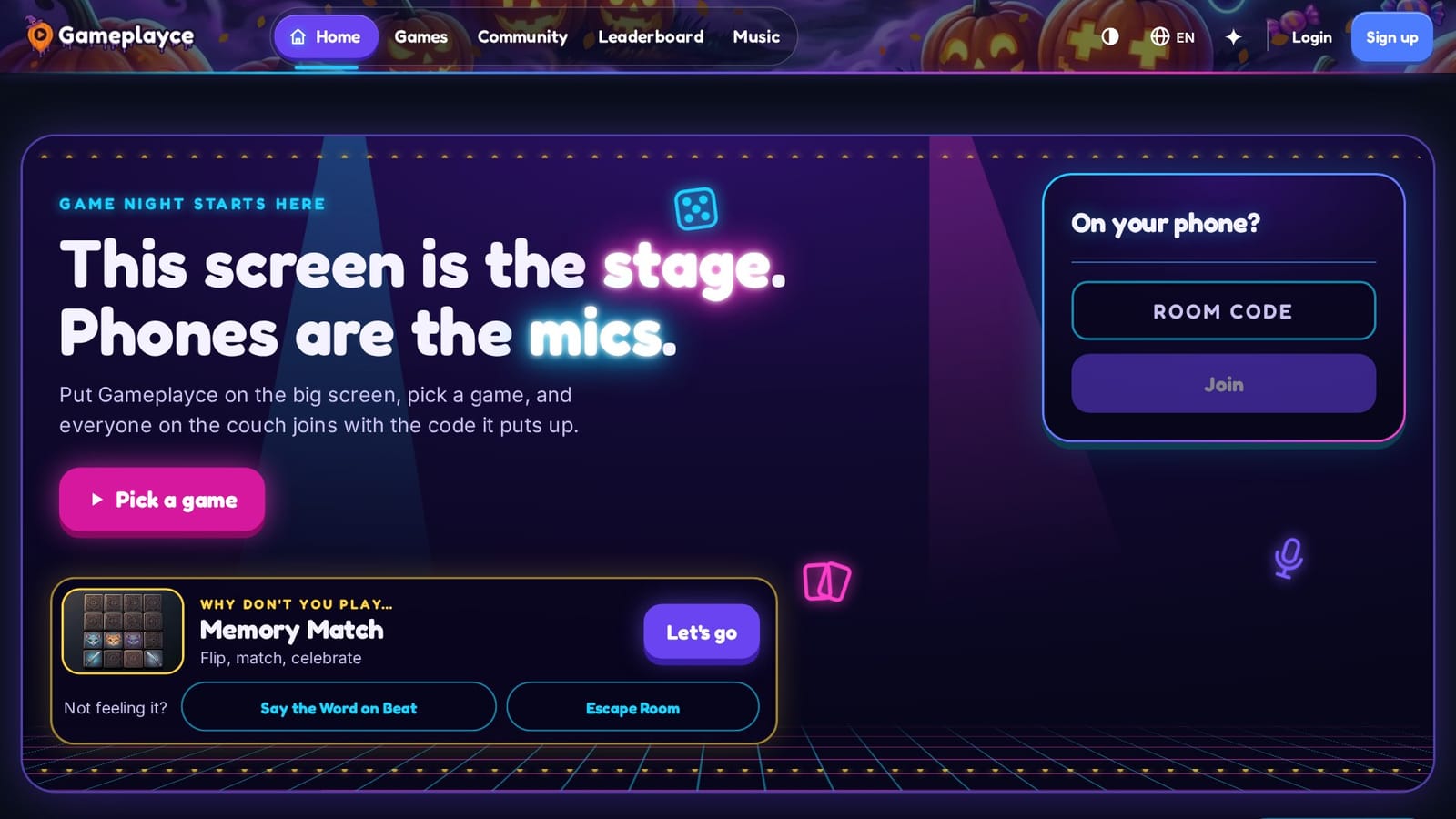
So Gameplayce is built on one rule: couch first. One screen is the stage, usually a TV or laptop. Phones are the controllers. Everyone joins with a room code. No installs, no accounts needed to play along. The games are designed for people in the same room: shouting across the couch, pointing at the TV, arguing about whose answer was funnier.
It isn't a remote-work icebreaker or a video-chat add-on, and it isn't trying to be a social network. It's an excuse to get together.
What's on the shelf
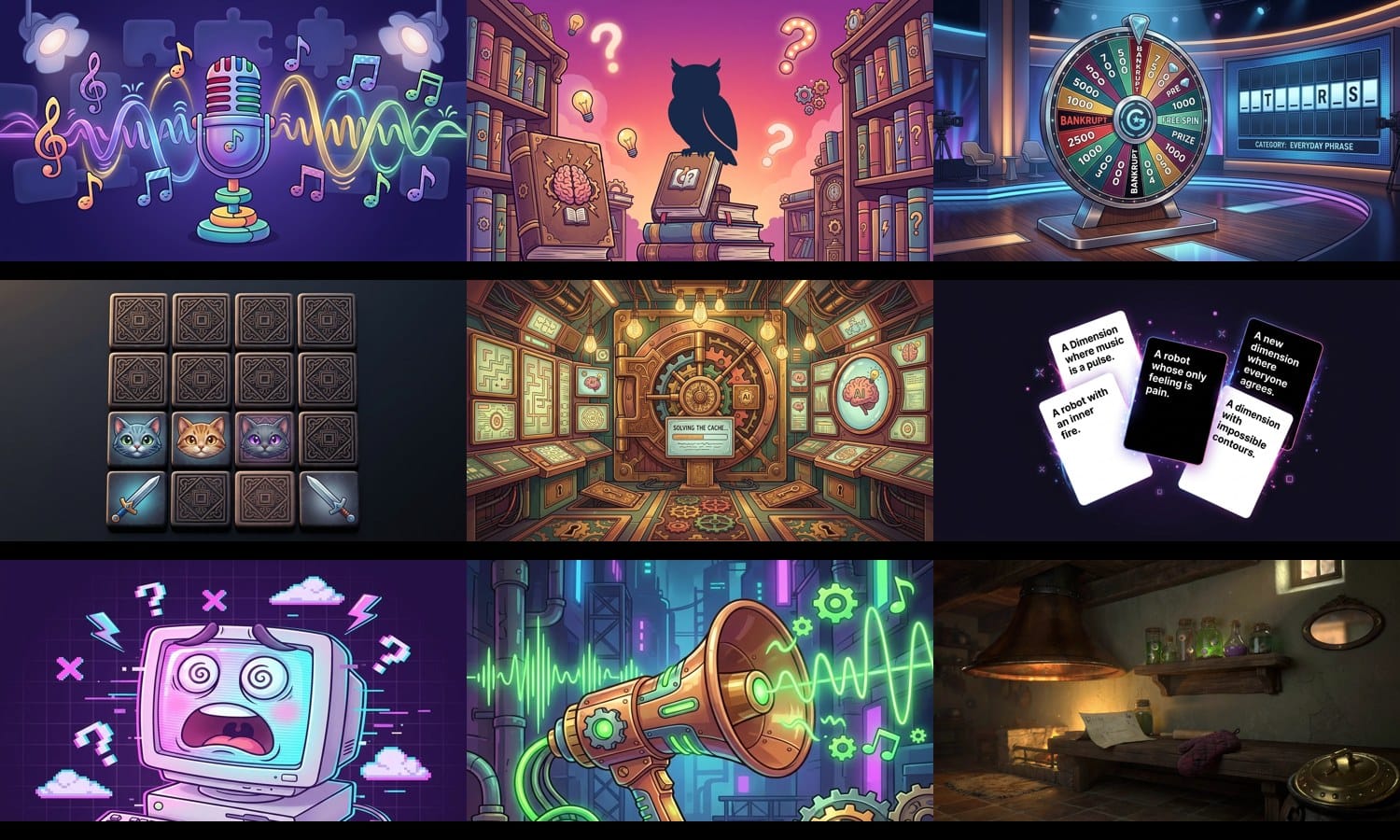
- Say the Word on Beat: words light up to the music and everyone shouts them out, on the beat. Our first hit, and the bar every other game gets measured against.
- Quiz Maker: build a quiz (by hand or with AI), host it on the TV, everyone answers on their phone.
- Cards Against Reality: black-card/white-card, family-friendly, AI-native, very silly.
- Wheel of Words: a co-op word-puzzle game show. The whole couch is one team, and Bankrupt hurts everyone.
- Memory Match: flip, match, celebrate, solo or with a room.
- Escape Room: a co-op puzzle room where what you inspect shows up only on your phone, so you have to talk to each other.
- Panic.exe: two-second microgames, everyone at once, the pace keeps rising.
- Shout Circuit: a co-op heist where your instructions are for a switch on someone else's phone. Shout it across the room.
- Fortune Teller: a tarot reading you can do alone or as a group.
Every game has its own look. There's a neon nightclub, a TV game-show studio, a candle-lit salon and a cyberpunk vault. They all share the same join flow, lobby and recap, so a game night can hop between them without anyone having to learn something new.
Free. Actually free.
For players, Gameplayce is free, and there's nothing to buy. No shop, no premium tier, no ads, no loot boxes, no "unlock this deck for €2.99". There are platform points, which you earn by playing and spend on things like AI-generating a quiz. They're earned, never bought. There's no purchase path in the code at all.
That's deliberate. Once players can pay, the platform starts optimizing for their spending: retention loops, upsells, dark patterns around the "buy" button. I'd rather it optimize for one thing: did people have a good evening together?
It runs self-hosted on my own hardware. The game art, the AI quiz generation and the music in the games, including the track in the trailer, come from models running on that same infrastructure. No third-party ad network, nobody's data for sale.
What I'd like from you
Try it at your next game night, office party or Friday evening with friends. Put gameplayce.io on the biggest screen in the room, pick a game, hand out the room code, and see what happens.
Then tell me what broke, which game landed and which one fell flat. Odds are an agent will have the fix up for review before I've finished my coffee.
We spend enough time with machines. Let's spend some of it with each other.
// COMMS